


Mr Davis was in his early fifties when the car accident happened. He recovered mentally within months, but during rehabilitation he could not sign paperwork or manage his own finances. Because he and his wife had registered a Property & Financial Affairs LPA years earlier, she carried on paying the mortgage and the bills without missing a beat. Without it, the joint account could have been restricted at the exact moment the household needed it most.
Practically, an LPA is not a document to start when there is an issue. It is a document to finish when everything is running smoothly
The Office of the Public Guardian (OPG) currently registers a Lasting Power of Attorney in 8 to 10 weeks, a figure it updated as recently as this July just gone. That is a significant improvement on the delays of a few years ago, and it is easy to read as good news and move on. But the number that actually matters is the processing time, when a mid-process LPA can do precisely nothing. A signed, posted, part-way-through-registration LPA has no legal standing whatsoever. Banks will not act on it, and care providers will not accept it. The document only becomes useful at the exact moment it stops being a work in progress, and until then, nobody can use it on your behalf, no matter how urgently they need to.
If capacity is lost before an LPA is registered, or was never begun, the only route is a deputyship through the Court of Protection. The two paths are not simply a faster and a slower version of the same thing. A deputyship requires a formal capacity assessment, a court application, and typically five to nine months before an order is granted, with an application fee of £400 to £420 before any solicitor’s costs, plus an ongoing annual OPG supervision fee of up to £320 and, in most cases, a security bond. An LPA costs £92 per document to register, and once registered, that is largely the end of the OPG’s involvement. The two processes couldn’t be more different.
There is a further difference that matters more in practice than the process and fee schedule. With an LPA, the donor chooses their attorney while they still have the capacity to choose well. With a deputyship, the court decides. That is usually a family member, but where there is any dispute or doubt, a professional deputy with no prior relationship to the family can be assigned by the court . One route keeps the choice inside the family. The other hands it to a judge who has never met them.
 None of this requires a dramatic health event to become relevant. Capacity can be affected by a stroke, a sudden accident, or something as gradual as dementia, whereby the time a diagnosis arrives, the window for making a valid LPA may already be closing. An LPA can only be created while the donor still understands what they are signing, which is the part of the process that behaves nothing like a will: a will can be updated for as long as someone is alive, but an LPA has to be made well before it is needed.
Two types of LPA exist in England and Wales, and most people need them both. A Property and Financial Affairs LPA covers bank accounts, bills, and property, and can be used with the donor’s consent even while they retain capacity, which is often overlooked. A Health and Welfare LPA covers care and medical decisions, and only takes effect once capacity is lost. Register both together, rather than one now and one later, and they move through the OPG in parallel rather than joining the queue at different times.
The mechanics of actually filling one out are where most applications can quietly go wrong. Three roles are involved, and they cannot overlap. The donor signs first, in front of an independent witness who is not one of the named attorneys. Next comes the certificate provider, someone who has known the donor personally for at least two years, or a relevant professional such as a GP or solicitor, confirming the donor understands what they are signing and is under no pressure to do it. The certificate provider’s signature does not itself need witnessing, but it must come before the attorneys sign. Only then do the attorneys, and any replacement attorneys, sign their own sections, each in front of a witness who is not the donor. Get the order wrong, and the whole application goes to the back of the queue.
The comparison to focus on is not having an LPA in place against the risks of deputyship. It is choosing to make one now instead of doing it eventually, because eventually is not a date any of us get to choose. A household with a will, a pension review, and a protection portfolio in good order can still be brought to a standstill by the one document sitting half-finished in a drawer, waiting for a quiet weekend that never quite arrives. Eight to ten weeks is a good deal shorter than it used to be, but it is still eight to ten weeks longer than families have once they discover they needed it yesterday. The OPG has no facility for retroactive urgency, however persuasively the case is made.

Sources: Office of the Public Guardian, About our services (GOV.UK, updated 10 July 2026), and OPG’s public witness/certificate provider guidance; Court of Protection deputyship fee and timescale data (Wilson Browne, GN Law, Fern Wills & LPAs); client case study (Fern Wills & LPAs); letter of wishes guidance (Legal & General, Lodders Solicitors)
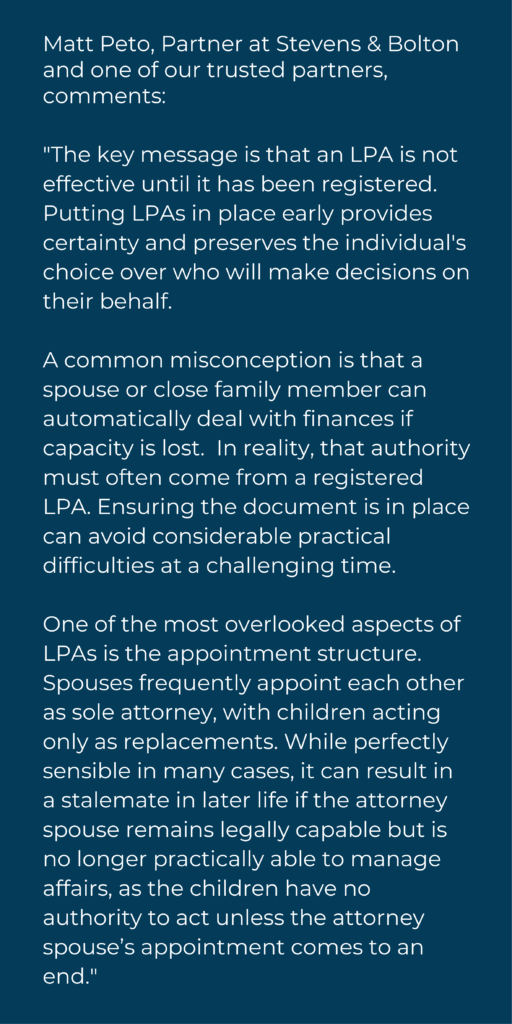
With thanks to our valued partner Matt Peto, Partner at Stevens & Bolton. Read more about Matt here.
Categories: Financial Planning, Property, Security